Children
Lives shaped by the immediate absence of fathers, altered family structures and explanations that were often partial or unavailable.
Liverpool · Chinese Diaspora · Intergenerational Memory
History did not end in 1946.
INJUSTICES 1946 is a Liverpool-based cultural research and storytelling project examining the afterlives of injustice across generations — and, more broadly, overlooked histories of Chinese diaspora communities in Britain.
PlaceLiverpool is our foundation.
History1946 is our point of departure.
MethodListening is our method.
FocusThe generations that followed are central to our story.
01 · Historical context
In 1946, Chinese merchant seamen in Liverpool were removed from Britain through a government repatriation operation, separating families and leaving many partners and children with little or no explanation.
The seamen form the historical foundation of this project, but they are not its only subject. Their story has increasingly entered public history, documentary and media. Our present inquiry asks what happened after the moment that is usually treated as the ending.
What did a disappearance mean inside a family? What was inherited by children who grew up with incomplete explanations, and by grandchildren who later returned to the archive in search of answers?
02 · After 1946
Our current research centres the children and grandchildren of families affected by 1946.
We are interested in how absence, interrupted kinship, silence, belonging, uncertainty and unanswered questions are carried, resisted and reinterpreted across generations.
Lives shaped by the immediate absence of fathers, altered family structures and explanations that were often partial or unavailable.
Later generations who encounter inherited stories, silences, documents and questions — sometimes becoming researchers of their own family histories.
How private family knowledge survives beside, outside or in tension with institutional records.
How historical injustice may continue through identity, relationships, belonging and the emotional work of making sense of the past.
We treat intergenerational trauma as a field of inquiry rather than a label imposed in advance. Testimony remains central to how descendants define the meaning of their own experience.
03 · Our symbol
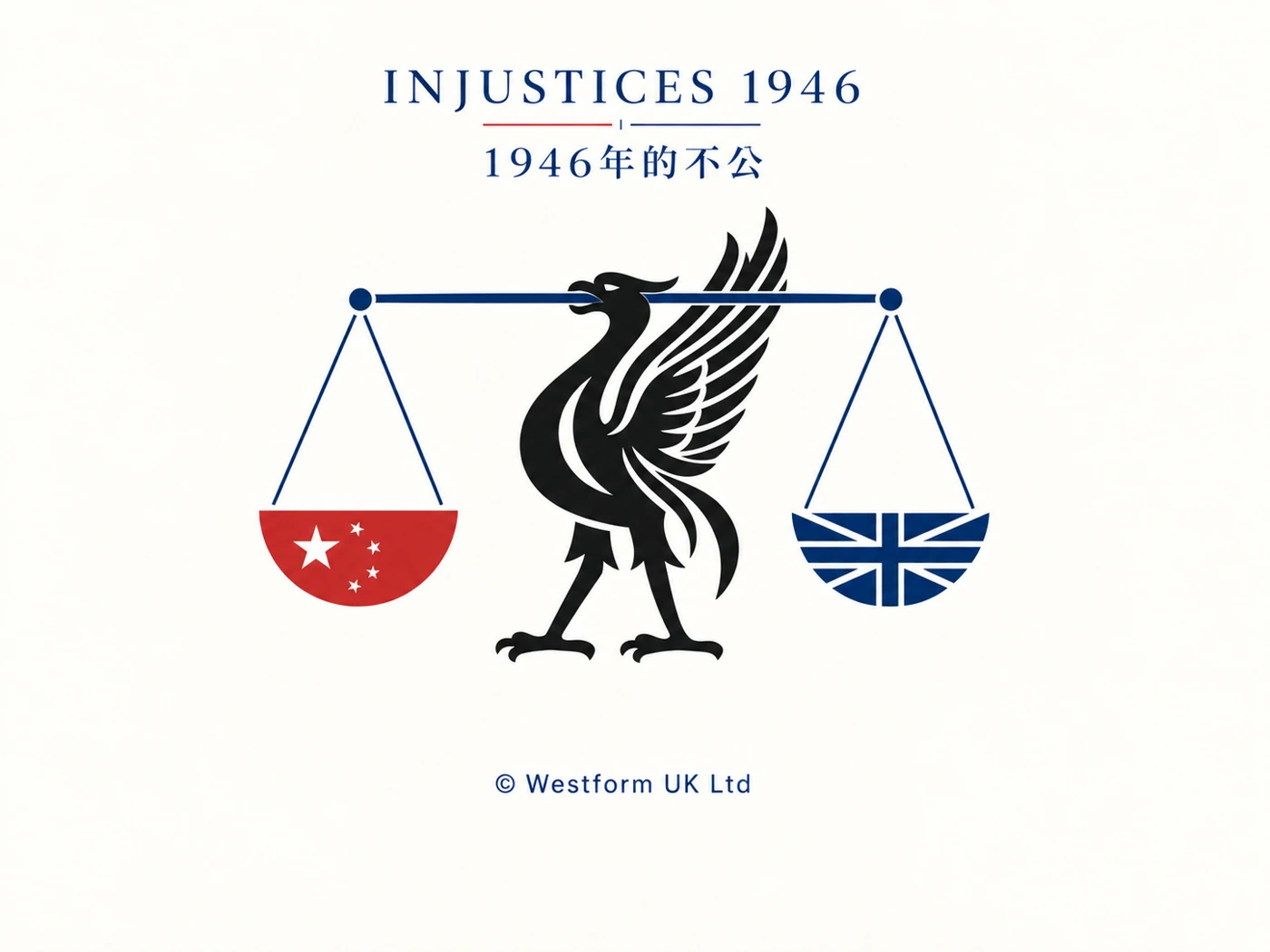
Our emblem brings together the three geographical coordinates from which the project emerged.
The Liver Bird anchors the mark firmly in Liverpool. The two suspended forms evoke lives and families shaped across Britain and China.
The balance is not intended to weigh one nation against another. It represents an imbalance in historical memory: between what entered the official archive and what survived in families; between histories publicly recorded and experiences carried privately across generations.
04 · Research approach
Listening is not simply how our work is consumed. It is part of how we research.
We bring oral testimony, archival material, environmental sound and experimental composition into conversation. Gaps, contradictions, silences and incomplete records are not treated as problems to hide, but as part of the historical condition we are trying to understand.
Descendants and community voices are approached as sources of knowledge, interpretation and lived historical experience.
Documents and records provide context, but are read critically alongside what families remember and what official files leave unsaid.
Documentary audio and composition offer another way to encounter absence, place and memory beyond conventional narration.
05 · Projects
Research and cultural storytelling focused on the children and grandchildren of families affected by the 1946 repatriations, and on the forms of memory and injustice carried across generations.
An experimental sonic work developed through testimony, archival fragments, environmental recordings and composition. It is intentionally not presented as a conventional podcast: its fragmented form asks how absence and incomplete evidence might be experienced through sound.
06 · Archive
The archive will grow with the research.
Rather than presenting a closed collection, we are building a space where historical records can sit beside oral testimony, family material and place-based memory.
Historical records and contextual research.
Testimony and intergenerational family narratives.
Photographs, locations, objects and memory.
07 · People
INJUSTICES 1946 combines sound practice, anthropological research, community knowledge and cultural storytelling.

Executive Producer · Sound Designer & Researcher
Kristina Chen (Qianbei Chen) is a sound designer and researcher working across oral history, documentary practice and sonic anthropology.
Her research interests include the histories, memories and lived experiences of Chinese diaspora communities in Britain, particularly stories that remain marginal to dominant public narratives. Her current work focuses on Liverpool and the intergenerational legacy of the 1946 repatriations, with particular attention to the children and grandchildren of affected families.
Her wider practice explores listening as a method of cultural research, bringing together oral testimony, archival material, environmental sound and experimental composition to investigate migration, memory, belonging and historical absence. She trained in Recording Arts before undertaking postgraduate study in Anthropology at UCL.
Business Executive
Joe supports the development of INJUSTICES 1946 through community connection, public engagement and the wider growth of the project.
His links with community networks help keep the work connected to lived histories rather than treating them only as archival subjects.
Beyond one event
The project began in Liverpool, but our wider research concerns overlooked histories, memories and lived experiences of Chinese diaspora communities across Britain.
Future work may follow other histories of migration, family separation, labour, racism, belonging, language, identity and intergenerational memory — particularly where public narratives remain incomplete and community knowledge carries what the archive cannot.
08 · Contact
We welcome contact from descendants, community members, researchers, cultural organisations and collaborators.
contact@injustices1946.com